The upload form was blunt about it: “File must be under 1 MB.” My scanned PDF was 6.4 MB. The job application wouldn’t go a step further until I fixed that.
If you’ve hit the same wall (a portal that caps uploads at 1 MB or 2 MB, or an email that bounces a fat attachment), here’s how to get a PDF under the limit in about thirty seconds, for free, and without handing your document to anyone.
I’ll use ToolsTray’s Compress PDF because I built it. The advice holds for any compressor, though, so I’ll start with what’s actually making your file big and what a good tool should do about it.
Why your PDF is so big (it’s the images)
A page of text is tiny, a few kilobytes. What blows a PDF up to megabytes is images: scanned pages, phone photos, the screenshots in a slide export. A 12-page scanned contract is really twelve photos in a trench coat.
That points straight at the fix: squeeze the images and leave everything else alone.
The trap: compressors that flatten every page
Here’s the honest tradeoff, and it’s the thing a lot of “free PDF compressor” sites get wrong. Many shrink a PDF by turning every page into one flat image. The file does get smaller, but your crisp, selectable text becomes a blurry picture. You can’t search it or copy a line out of it, and it looks soft on screen.
A better compressor recompresses only the embedded images and copies the text and vector graphics through untouched. ToolsTray’s Compress PDF re-encodes each photo with the MozJPEG encoder at the quality you pick, so the words stay sharp and selectable. That’s the one thing I’d check for in whatever tool you choose.
Type the limit into Target size
Here’s the whole job:
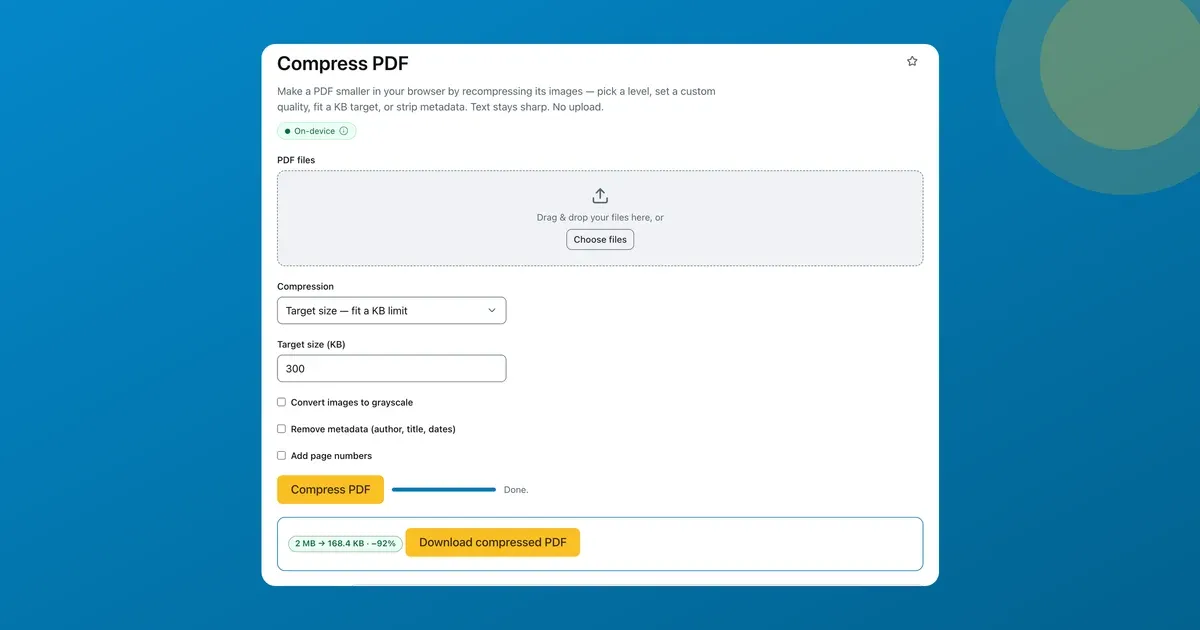
- Open Compress PDF and drop your file in. It never uploads, which matters when the PDF is a contract or an ID.
- Choose Target size and type your limit in KB (
1000for 1 MB, or200if a form is stricter). - Download. The tool steps through progressively stronger compression and keeps the lightest result that still fits under your number.

Target-size mode in action: a 2 MB scan aimed at 300 KB came out at 168.4 KB (−92%), all on your device.
If you don’t need an exact ceiling, skip Target size and pick Balanced, the right call for most reports and decks. Use Light when the photos must stay crisp and Strong when all that matters is making it small.
When it barely shrinks (and that’s fine)
Compression isn’t magic. If a PDF is mostly text, already optimized, or built from image types that can’t be safely recompressed, there’s little to remove, and a good tool tells you the smallest size it managed instead of mangling the file. ToolsTray’s will never hand you a copy larger than the original.
If a text-only PDF is somehow huge, the weight is usually embedded fonts or junk metadata rather than images, and that needs a different fix.
Why “no upload” is the part I care about
When the compression happens on your machine, your document never touches a server. For a payslip or a passport scan, the real choice is between trusting a random website with your ID and keeping the file on your laptop the whole time. Open your browser’s network tab while you use it and watch: nothing goes out.
It’s also why it’s free with no sign-up. There’s no server bill to cover when your own device does the work.